
Neuroaffirming Care: 5 Principles for Therapists
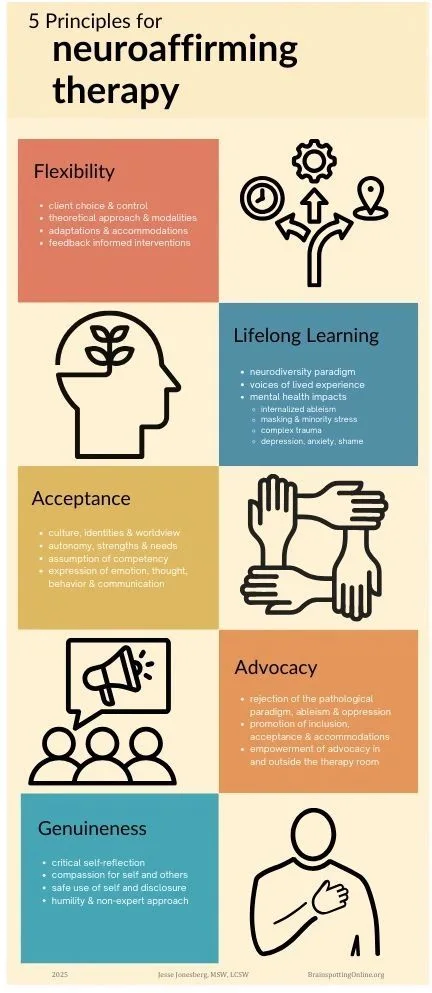
Neuroaffirming therapy (NAT) is not a specific modality of therapy like CBT or DBT. Rather it is a broader term used to describe a way of working with individuals that honors neurodiversity in the therapy session. Much like trauma informed care (TIC) or cultural humility (CH), neuroaffirming therapy seeks to inform how us therapists view, think about, and interact with the client in front of us. Neuroaffirming therapy is a general term for a therapy approach that embraces neurodiversity with 5 core principles: flexibility, lifelong learning, acceptance, advocacy, and genuineness.
Flexibility
A neuroaffirming approach to therapy requires flexibility in how we work with our clients to accommodate their preferences, needs, and goals. Being flexible also allows room for the client to have choice and control - fundamental aspects of both trauma informed care and neuroaffirming practice perspective (SAHMSA, 2014; Crowe, 2024). Before the therapy session we can seek client input in terms of the physical environment, communication preferences, therapeutic goals, and therapeutic processes. We can support them in exploring which types of therapeutic approaches or modalities are best for their healing and recovery. To this end, it can be helpful for therapists to curate a variety of therapy approaches to best fit different client preferences and needs (Neff, 2024). By being flexible we can avoid becoming the “expert,” and allow for the client to lead the way in framing the session and determining how best to proceed in the therapy room.
Evidence Based Practices (EBPs) are sometimes seen as the gold standard in determining if a therapy model is valid. From a neurodiversity lens, these approaches can fall short and even be potentially harmful to certain populations (Wendt, et al., 2015; Resnick, 2023). Many EBPs were developed or researched with a neurotypical client in mind, so it is important that therapists apply flexibility in how we view and use EBPs with neurodivergent clients. When we adopt a flexible approach, we can be responsive to our client’s needs and make adaptations and accommodations during the therapy session. By de-emphasizing our “expert therapist” knowledge we can aspire to humility. We can apply flexibility to how we use our therapy models to be more responsive, creative, and accommodating during the therapy session (Knoff, 2024).
Seeking and integrating client voice is an anchor in therapy, especially from a neuroaffirming perspective (Rae-Hodgson, 2022). During the session, a client may offer us covert or overt communication, and we can also intentionally elicit client feedback or “check in” with the client during the session to inform our practice. Eliciting feedback from clients following the therapy session cam help us assess what worked well and what did not work well during the session. I find that checking in with clients after the session frequently helps me to be a better therapist in general and to communicate, attune, and support clients more effectively in the long run.
Lifelong Learning
The idea of a neuroaffirming therapy approach is founded on the neurodiversity paradigm which is contrasted with the pathological paradigm that is predominant in modern western culture (Walker, 2013). A neuroaffirming approach will be well versed in the neurodiversity paradigm, and when we use this perspective in the therapy room it will affect how we compose our case formulations, implement our therapeutic interventions, and how we behave and communicate in the therapy room.
The pathology paradigm has become the norm in western societies, it is based on rigid ideas of “normalcy” and “right” ways of thinking about, interacting with, and being in the world. Individuals who fall outside of these “normal” standards are labeled as disordered and in need of fixing. In mental health, the pathology paradigm can be seen in the medical model, the Diagnostic and Statistical Manual (DSM), and the strict adherence to mental health Evidence Based Practices (EBPs) (Walker, 2013). In contrast, the neurodiversity paradigm views diversity in human behavior, thought and communication as natural, normal, and even valuable in a society. Instead of seeing neurodivergent individuals as problems to be fixed, the neurodivergent paradigm invites therapists to embrace neurodiversity, to explore ways of changing oppressive systems, and to find accommodations for people who do not conform to the “normal” (CDR, 2024; Knoff, 2024; Walker, 2013).
Ablism is a crucial concept for a neuroaffirming therapist to understand and integrate into their work with clients, it is defined as “a set of beliefs or practices that devalue and discriminate against people with physical, intellectual, or psychiatric disabilities…” (CDR, 2024). Neurodivergent folks experience many mental health issues, stressors, and trauma due to the impacts of socially sanctioned ablism. Critical self-reflection is required for any therapist who seeks to learn more about oppression, neurodiversity, and the impacts of ableism. As therapists and peers, we can identify ways in which our lives and the lives of those that we love have been touched being labeled as “weird,” “not normal,” or “disordered.” Isolation, invalidation, bullying, neglect, and trauma are just some of the ways that ableism can impact our mental health. As aspiring neuroaffirming therapist we also need be connected to neurodivergent voices and community and understand some of the serious mental health impacts related to being labeled as not normal. By hearing the experiences of others with neuro differences we can expand our understanding and learn from firsthand experiences (Dundon, 2023). Our world is one of neuro-normalcy. It is a world that values the (nonexistent) neurotypical experience, while implicitly and explicitly devaluing the experiences of the neurodivergent. Issues related to mental health and trauma are intimately tied to the dominant pathological paradigm and can manifest in an individual as: internalized ableism, bullying, trauma, minority stress, masking, depression, anxiety, shame, among others (Andoni, 2024; Knoff, 2024; Sedgewick et al., 2021; Seers & Hogg, 2023).
Acceptance
Perhaps one of the most obvious qualities of a neuroaffirming therapy is acceptance. A therapist who aims to be neuroaffirming works to accept a client’s culture, identities, and worldview. Neuroaffirming therapy demands that we understand and accept different ways of experiencing the world, different approaches to thinking about the world, and the variety of ways that humans can feel emotions, engage in communication, and behave – all without the pathological paradigm’s judgment of “right” and “wrong” ways of being. A neuroaffirming approach does not see neuro differences as a problem to be fixed, instead mental health and stress issues relate to exclusion and marginalization. Internalized ableism, minority stress, complex trauma related to exclusion, etc. are often the causes of distress and suffering. The neurodivergent client is not the problem, the neurodivergent individual is largely experiencing suffering related to the impacts of exclusion, marginalization, stigmatization, and internalized ablism (Knopf, 2024; Mullaly, 2010; Walker, 2013).
Accepting also means setting aside our preconceptions about what “therapy” or “mental health” means. Therapists are not experts on another person’s lives, struggles, and goals. Instead, we seek to understand healing, recovery, and wellness from the client’s perspective. We also seek to understand how our clients experience emotion, thought, behavior, and communication. By trusting and assuming the client’s competency and wisdom, we can allow them the autonomy and the right to self-determination in and out of the therapy room. This approach accepts that there is not one way to be autistic or any other identity. We seek to emphasize autonomy, build on strengths, and tailor our approach to current client needs and goals. The client has a right to be seen through the lens of their own culture, experience, and worldviews without judgement (Peters, 2023).
Advocacy
The neuroaffirming approach to therapy promotes and advocates for the acceptance, inclusion, and value of neurodiversity among humanity. This approach rejects the supremacy of the pathological paradigm. A neuroaffirming therapist will have a solid understanding of ableism, marginalization, and exclusion (Knopf, 2024). The therapist aims to integrate these social experiences into the therapeutic process and empower the voice of the client in advocating inside and outside the therapy room. We can collaborate with clients to identify opportunities to connect with community, engage in advocacy work, and take action to make changes in our community. We can work with clients to develop advocacy skills and strategies, and as neuroaffirming therapists we can also model these advocacy skills in our personal and professional lives (Couchman, 2025).
Engaging in advocacy efforts can empower both the client and therapist in their work. Connecting to social issues, demanding accommodations, and working towards systemic change can help build ones self-efficacy. Conceptualizing suffering within the context of social inequality and equity can help reduce self-blame, stigma, and shame. In this way, neuroaffirming therapy provides explanation, social context, and validation to a neurodiverse individual’s suffering. It connects the individual to a larger community and social movement and can help displace some of the inevitable self-hatred that one has developed as a result of internalized ablism and socially engineered trauma (Avruch & Shaia, 2022; Peters, 2023).
Genuineness
Genuineness has long been known to be a foundational ingredient in relational therapy. A therapist’s genuineness involves both the therapist’s ability to be aware of their own experience and also to be able to convey these experiences to the client (Kolden, et al., 2018). The quality of genuineness is also a key part of being a neuroaffirming therapist (Wise, 2023). When a therapist is genuine, it can convey a sense of integrity or trustworthiness. A genuine therapist can model a quality of self-acceptance and compassion for self and other during the session, and this quality can play a part in creating a space that feels safe.
The quality of being genuine in the therapy room required that a therapist notices and accepts their faults, quirks, and limitations. It requires that we engage in critical self-reflection, that we reflect on how we may have benefited from and harmed by ableism. In the context of neurodivergence, it may be particularly important the therapist develop insight into their own neurotype and ways of being in the world. When we are genuine, we use self-disclosure / safe use of self, and this is an especially important skill of a neuroaffirming therapist (Crowe, 2024). Genuineness can also allow the therapist to approach interaction with clients from a non-expert stance of humility, which is another crucial component of working effectively with neurodivergent folks (Chapman & Botha, 2023).
Works Cited
Andoni, L. (2024) Autistic Adults' Ableist and Neurodiversity Affirming Experiences in Therapy. Graduate Doctoral Dissertations. 975.
https://scholarworks.umb.edu/doctoral_dissertations/975
Avruch, DaD. & Shaia, W. (2022). Macro MI: Using Motivational Interviewing to Address Socially-engineered Trauma. Journal of Progressive Human Services, 33(2).
CDR (2024). #Abilism. Center for Disability Rights. Retrieved from: https://cdrnys.org/blog/uncategorized/ableism/\
Chapman, R., & Botha, M. (2023). Neurodivergence-informed therapy. Developmental medicine and child neurology, 65(3), 310–317.
Couchman, B. A. (2025). Ways Forward: Progressive Approaches to Providing Therapy with Autistic Individuals.Vernon Art and Science Incorporated.
Crowe, C. (2024). Neurodivergent-Affirming Clinical Practices and Psychological Safety. Dig a Little Deeper Psychotherapy and Counseling. Retrieved from: https://digalittledeeper.ca/creating-neurodivergent-affirming-clinical-practices/
Knopf, E. (2024). The Neuroaffirming Therapy Handbook: a practitioners guide to working with autism and ADHD. Endi Books.
Kolden, G. G., Wang, C. C., Austin, S. B., Chang, Y., & Klein, M. H. (2018). Congruence/genuineness: A meta-analysis. Psychotherapy (Chicago, Ill.), 55(4), 424–433. https://doi.org/10.1037/pst0000162
Lerner, M. D., Gurba, A. N., & Gassner, D. L. (2023). A framework for neurodiversity-affirming interventions for autistic individuals. Journal of consulting and clinical psychology, 91(9), 503–504. Retrieved from: https://pmc.ncbi.nlm.nih.gov/articles/PMC10430771/
Neff, C. (2024). Neurodivergent Affirming Practice: Helping Your Clients Accept Their Authentic Selves. Neurodivergent Insights. Retrieved from: https://neurodivergentinsights.com/blog/neurodivergent-affirming-practices
Mullaly, B. (2010). Challenging oppression and confronting privilege: A critical social work approach (2nd ed.). Oxford University Press.
Peters, A. (2023). The DIVERSE model – 7 principles of Neurodivergent Affirming Practice. Retrieved from: https://newgladecounselling.co.uk/2023/09/12/the-diverse-model-7-principles-of-neurodivergent-affirming-practice/
Rae-Hodgson, R. (2022). Neurodiversity-Affirming Practice in Mental Health - Lived Experience Feedback. Chronic Resilience: Lived Experience Occupational Therapy. Retrieved from: https://www.chronicresilienceot.com/blog/neurodiversity-affirming-practice-in-mental-health-lived-experience-feedback
Resnick, A. (2023). What Does it Mean to Be Neurodivergent?. Very Well Mind. Retrieved from: https://www.verywellmind.com/what-is-neurodivergence-and-what-does-it-mean-to-be-neurodivergent-5196627
Roberts, J. (2022). Neurodiversity-Affirming Therapy: Positions, Therapy Goals, and Best Practices. Therapist Neurodiversity Collective. Retrieved from: https://therapistndc.org/neurodiversity-affirming-therapy/
Seers, K., & Hogg, R. (2023). “Fake it ‘till you make it”: Authenticity and wellbeing in late diagnosed autistic women. Feminism & Psychology, 33(1), 23-41. Retrieved from: https://journals.sagepub.com/doi/full/10.1177/09593535221101455
Silvester, S.-J. E., & Rankine, R. (2024). Neurodiversity-affirming school counselling: supporting neurodivergent student wellbeing with person-centered therapy. Journal of Psychologists and Counsellors in Schools, 34(3), 266-284. https://doi.org/10.1177/20556365241267050
SAMHSA (2014). SAMHSA’s Concept of Trauma and Guidance for a Trauma-Informed Approach. HHS Publication No. (SMA) 14-4884. Rockville, MD: Substance Abuse and Mental Health Services Administration, 2014. Retrieved from: https://ncsacw.acf.hhs.gov/userfiles/files/SAMHSA_Trauma.pdf
Walker, N. (2013). Throw Away the Master’s Tools: Liberating Ourselves from the Pathology Paradigm. Neuroqueer. Retrieved from: https://neuroqueer.com/throw-away-the-masters-tools/
Wendt, D. C., Gone, J. P. & Nagata, D. K. (2015). Potentially Harmful Therapy and Multicultural Counseling: Bridging Two Disciplinary Discourses. The Counseling Psychologist, 43(3), 334-358. Retrieved from: https://journals.sagepub.com/doi/full/10.1177/0011000014548280#bibr22-0011000014548280
Wise, J. (2023). Neurodiversity Affirming Practice Core Principles. Lived Experience Educator. Retrieved from: https://www.livedexperienceeducator.com/neurodiversityaffirmingpractice
We teach this in our Neurodiversity training for helping professionals across Wisconsin. Discuss training for your team, or browse more posts.
Newsletter: one email a month with practical ideas for helping teams. Sign up